AAAI · 2026
Adaptive Riemannian Graph Neural Networks
Proceedings of the AAAI Conference on Artificial Intelligence
AAAI · 2026
One graph, many local geometries
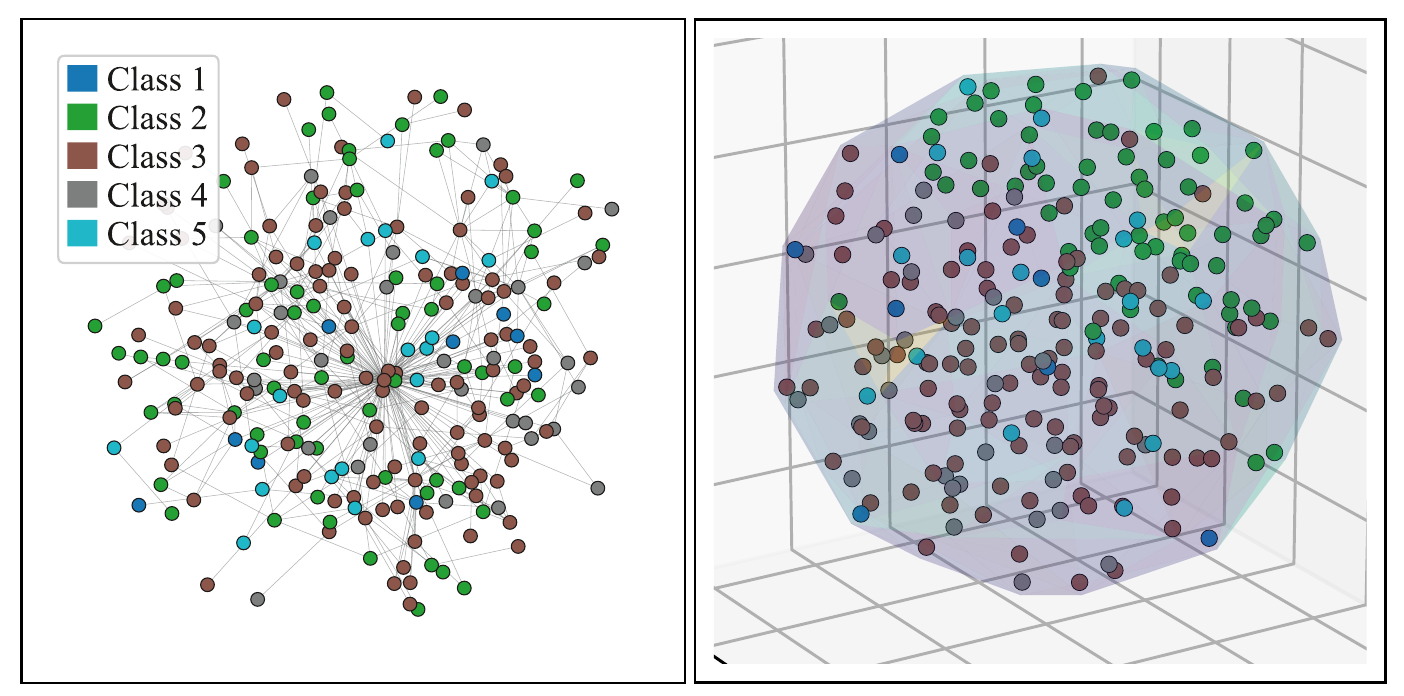
The Wisconsin network has heterogeneous local structure. Its topology and feature embedding motivate learning a separate Riemannian metric at each node rather than imposing one geometry on the entire graph.
Adaptive Riemannian Graph Neural Networks Figure 1 from the paperHow can a graph model adapt to different local geometries?
ARGNN learns a node specific Riemannian metric instead of imposing one fixed curvature on an entire graph. A diagonal metric parameterization and geometric regularization support efficient training, with convergence analysis and experiments on homophilic and heterophilic graphs.
Research themes
Cite this paper
Xudong Wang, Chris Ding, Tongxin Li, Jicong Fan. Adaptive Riemannian Graph Neural Networks. Proceedings of the AAAI Conference on Artificial Intelligence, 2026. https://doi.org/10.1609/aaai.v40i31.39869
BibTeX
@inproceedings{tongxin-argnn,
  title = {{Adaptive Riemannian Graph Neural Networks}},
  author = {Xudong Wang and Chris Ding and Tongxin Li and Jicong Fan},
  year = {2026},
  booktitle = {Proceedings of the AAAI Conference on Artificial Intelligence},
  url = {https://doi.org/10.1609/aaai.v40i31.39869},
  doi = {10.1609/aaai.v40i31.39869}
}
Related papers
Energy Injection Identification enabled Disaggregation with Deep Multi-Task Learning
DualNILM jointly recognizes appliance states and identifies energy injected behind the meter. Its transformer architecture combines temporal learning tasks to separate consumption from injections, with evaluation on measured and synthesized datasets.
Quantum Learning and Estimation for Coordinated Operation between Distribution Networks and Energy Communities
A hybrid quantum learning model estimates energy community responses to prices, while quantum amplitude estimation supports uncertainty calculations. Numerical studies assess accuracy and resource requirements. Reported timing advantages assume ideal quantum devices rather than deployed hardware.
World Models in Pieces: Structural Certification for General Agents
Structural certification links performance on compositional goals to local guarantees on world model transitions. The results identify reliable pieces of a model without requiring universal competence, and establish limits on the precision of such guarantees.