NeurIPS · 2024
Disentangling Linear Quadratic Control with Untrusted ML Predictions
Advances in Neural Information Processing Systems
NeurIPS · 2024
Learning which predictions to trust
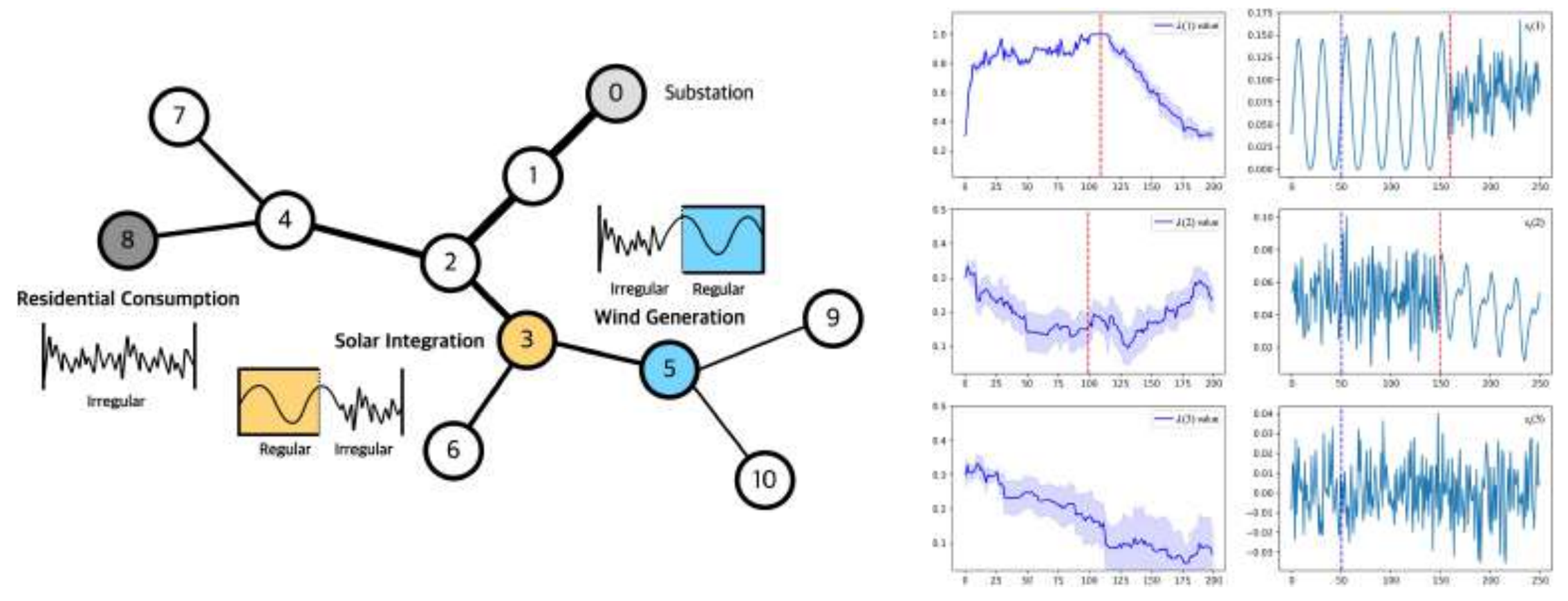
In this voltage control example, confidence in solar predictions falls when generation becomes less regular, while confidence in wind predictions rises as the signal becomes more regular. DISC learns trust separately for each source.
Disentangling Linear Quadratic Control with Untrusted ML Predictions Figure 3 from the paperCan a controller learn which components of a forecast to trust?
DISC learns confidence in predictions of latent disturbance components. Competitive analysis covers linear and more general mixing functions, showing how online confidence adaptation can exploit accurate forecasts while maintaining protection against large errors.
Research themes
Connections
From prediction error to control performance
Trust adaptation in linear quadratic control and perturbation bounds for MPC connect the quality of a forecast to the cost of acting on it. Nonlinear certification adds stability to this picture.
Open questions
Prediction quality as a decision resource
Which prediction errors actually matter for the decision being made?
Explore open directionsCite this paper
Tongxin Li, Hao Liu, Yisong Yue. Disentangling Linear Quadratic Control with Untrusted ML Predictions. Advances in Neural Information Processing Systems, 2024. https://papers.nips.cc/paper_files/paper/2024/hash/9dff3b83d463fab213941bfee23341ba-Abstract-Conference.html
BibTeX
@inproceedings{tongxin-disc,
  title = {{Disentangling Linear Quadratic Control with Untrusted ML Predictions}},
  author = {Tongxin Li and Hao Liu and Yisong Yue},
  year = {2024},
  booktitle = {Advances in Neural Information Processing Systems},
  url = {https://papers.nips.cc/paper\_files/paper/2024/hash/9dff3b83d463fab213941bfee23341ba-Abstract-Conference.html}
}
Related papers
Certifying Black-Box Policies With Stability for Nonlinear Control
Simply blending two stabilizing policies can cause instability. An adaptive confidence policy instead uses approximate model information to certify stability, with competitive guarantees under bounded nonlinearity and evaluations on Cart Pole and charging under distribution shift.
Bounded-Regret MPC via Perturbation Analysis: Prediction Error, Constraints, and Nonlinearity
A general analysis pipeline converts perturbation bounds for finite horizon control into dynamic regret bounds for MPC. It handles prediction errors in costs, dynamics, and disturbances, and extends the analysis to constrained and nonlinear settings under suitable regularity conditions.
Robustness and Consistency in Linear Quadratic Control with Untrusted Predictions
A confidence parameter governs how much a linear quadratic controller trusts disturbance predictions. Competitive bounds describe the tradeoff between accurate and inaccurate advice, and a self tuning policy adapts confidence online using observed prediction quality.