CDC · 2025
INSTRUCT MPC: A Human-LLM-in-the-Loop Framework for Context-Aware Control
IEEE Conference on Decision and Control
CDC · 2025
Turning context into control
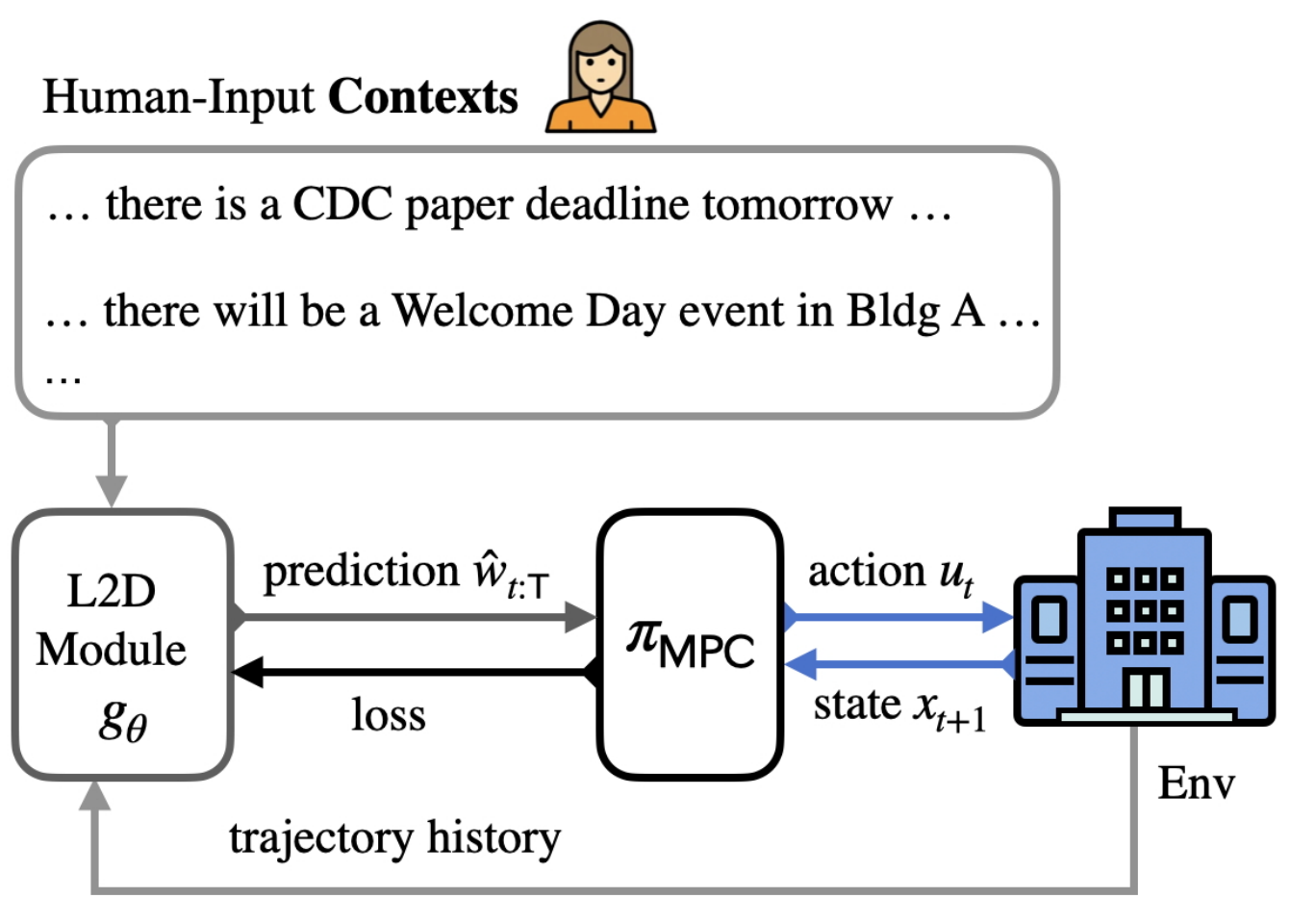
A schedule change or human instruction becomes a disturbance prediction. INSTRUCT MPC uses that prediction to choose an action, then learns from the environment's feedback.
INSTRUCT MPC: A Human-LLM-in-the-Loop Framework for Context-Aware Control Figure 1 from the paperHow can human instructions improve predictive control?
A language to distribution module converts contextual instructions into disturbance predictions for MPC. The framework closes the loop between instructions, predictions, and control, with a regret analysis for linear dynamics under the stated training assumptions.
Research themes
Connections
From language context to constrained actions
INSTRUCT MPC translates human instructions into disturbance predictions. World model certification and VigilMPC study complementary ways of deciding which learned models can support reliable planning and safe updates.
Context becomes an energy system input
OpenCEM motivates shared contextual energy benchmarks. INSTRUCT MPC uses instructions for control, while counterfactual load forecasting represents news events as interventions on electricity demand.
Open questions
Certified contextual control
Can contextual and world model updates be certified before they affect a physical system?
Explore open directionsCite this paper
Ruixiang Wu, Jiahao Ai, Tongxin Li. INSTRUCT MPC: A Human-LLM-in-the-Loop Framework for Context-Aware Control. IEEE Conference on Decision and Control, 2025. https://doi.org/10.1109/CDC57313.2025.11312156
BibTeX
@inproceedings{tongxin-instruct-mpc,
  title = {{INSTRUCT MPC: A Human-LLM-in-the-Loop Framework for Context-Aware Control}},
  author = {Ruixiang Wu and Jiahao Ai and Tongxin Li},
  year = {2025},
  booktitle = {IEEE Conference on Decision and Control},
  url = {https://doi.org/10.1109/CDC57313.2025.11312156},
  doi = {10.1109/CDC57313.2025.11312156}
}
Related papers
Counterfactual load forecasting with LLM-structured events and representation learning
NACF turns news into structured treatments and estimates load trajectories under alternative event conditions. Reweighting and representation balancing address observed confounding. Experiments examine factual accuracy and interpretable demand perturbations without claiming that unobserved counterfactual outcomes can be directly validated.
VigilMPC: Certified Online Tube Model Predictive Control for Safe Real-Time Neuromodulation
VigilMPC accepts a predictor update only when a backup plan remains feasible under tightened constraints. Recursive feasibility and constraint satisfaction follow under the tube MPC assumptions. Evaluation uses simulated neural dynamics and a switching benchmark, rather than clinical deployment.
World Models in Pieces: Structural Certification for General Agents
Structural certification links performance on compositional goals to local guarantees on world model transitions. The results identify reliable pieces of a model without requiring universal competence, and establish limits on the precision of such guarantees.
Open In-Context Energy Management Platform
OpenCEM presents a platform design connecting energy time series, events, human context, and simulation. An on campus solar and battery installation motivates evaluation of context sensitive control. The paper describes planned data and API capabilities.